 Get A Quote





From Panic to Positioning

The shift from novelty to reality is definitely here, but for those of us in the creative and strategic space, that “Wait, is this happening?” moment is actually a massive door opening. In marketing and visual communication, the panic often stems from the idea of replacement, when the reality is more about supercharged refinement.
Bridging the Gap Between Technical and Visual
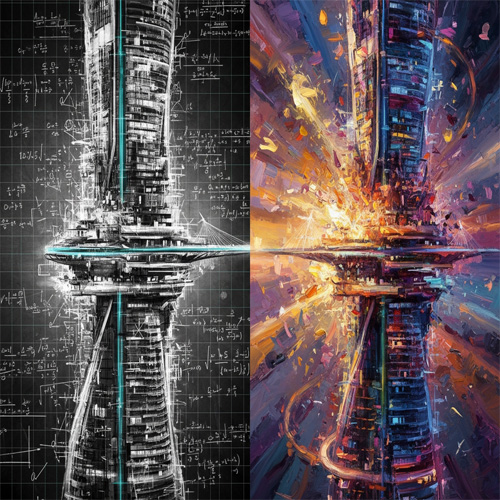
For companies that do complex, technical work—like manufacturing or specialized engineering—the struggle has always been making the “back of the house” look as sophisticated as the product itself. AI allows us to take technical data or rough site photos and transform them into high-end visual storytelling. It’s about taking a company’s invisible expertise and making it visible to a digital-first audience.
The Death of “Placeholder” Culture

We’ve all been there: waiting weeks for a specialized photoshoot or settling for generic stock images that don’t quite fit the brand.
Hyper-Customization: Businesses can now generate specific, surreal, or geometric visual compositions that match a brand’s unique aesthetic perfectly.
Iterative Speed: We can test ten different visual directions in an afternoon, seeing how a campaign feels in high-contrast or minimalist styles before a single cent is spent on large-scale production.
Precision Messaging at Scale

Marketing used to be a choice between “personal” and “fast.” AI removes that trade-off.
Narrative Flow: It helps maintain a consistent, rhythmic voice across every touchpoint—from a deep-dive blog post to a quick LinkedIn update—ensuring the brand narrative never feels disjointed.
B2B Personalization: In the B2B world, you can tailor high-level campaign assets to speak specifically to different distributors or factory reps, making each partner feel like the primary focus.
Strategic Positioning, Not Just Content
The real value isn’t just in “making things.” It’s in the strategy behind the visuals. AI acts as a research partner that can analyze industry trends or sustainability impact—like solar energy ROI or aerosol return programs—and help translate those dry facts into compelling visual narratives. It handles the “heavy lifting” of data so that the creative direction can stay focused on the “big picture.”
The FreshBrain Takeaway
At the end of the day, history shows us that “new tech panic” is a cycle. We freaked out about the printing press, the steam engine, and the internet. Usually, we don’t end up in a Terminator-style apocalypse; we just end up in a world that looks very different from the one we grew up in. But for businesses willing to evolve, the future looks more professional, more aligned, and much more capable of showcasing the true quality of the work they do.
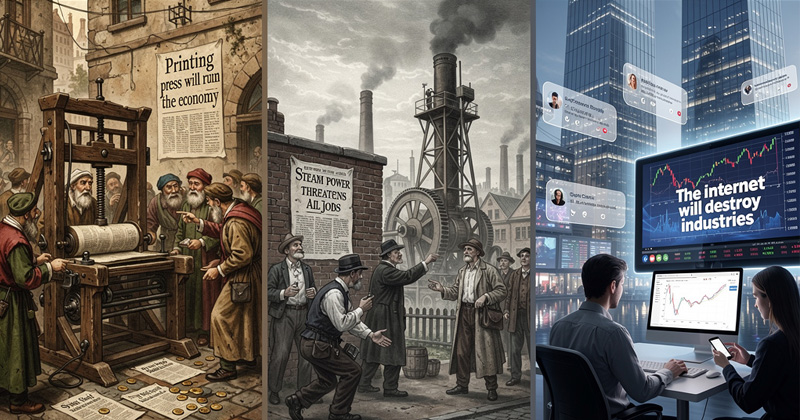
Original Illustrations by FreshBrain Creative Agency
From Panic to Positioning
The shift from novelty to reality is definitely here, but for those of us in the creative and strategic space, that “Wait, is this happening?” moment is actually a massive door opening. In marketing and visual communication, the panic often stems from the idea of replacement, when the reality is more about supercharged refinement.
Here is how AI is actually moving the needle for businesses:
Bridging the Gap Between Technical and Visual
For companies that do complex, technical work—like manufacturing or specialized engineering—the struggle has always been making the “back of the house” look as sophisticated as the product itself. AI allows us to take technical data or rough site photos and transform them into high-end visual storytelling. It’s about taking a company’s invisible expertise and making it visible to a digital-first audience.
The Death of “Placeholder” Culture
We’ve all been there: waiting weeks for a specialized photoshoot or settling for generic stock images that don’t quite fit the brand.
Hyper-Customization: Businesses can now generate specific, surreal, or geometric visual compositions that match a brand’s unique aesthetic perfectly.
Iterative Speed: We can test ten different visual directions in an afternoon, seeing how a campaign feels in high-contrast or minimalist styles before a single cent is spent on large-scale production.
Precision Messaging at Scale
Marketing used to be a choice between “personal” and “fast.” AI removes that trade-off.
Narrative Flow: It helps maintain a consistent, rhythmic voice across every touchpoint—from a deep-dive blog post to a quick LinkedIn update—ensuring the brand narrative never feels disjointed.
B2B Personalization: In the B2B world, you can tailor high-level campaign assets to speak specifically to different distributors or factory reps, making each partner feel like the primary focus.
Strategic Positioning, Not Just Content
The real value isn’t just in “making things.” It’s in the strategy behind the visuals. AI acts as a research partner that can analyze industry trends or sustainability impact—like solar energy ROI or aerosol return programs—and help translate those dry facts into compelling visual narratives. It handles the “heavy lifting” of data so that the creative direction can stay focused on the “big picture.”
The FreshBrain Takeaway
At the end of the day, history shows us that “new tech panic” is a cycle. We freaked out about the printing press, the steam engine, and the internet. Usually, we don’t end up in a Terminator-style apocalypse; we just end up in a world that looks very different from the one we grew up in. But for businesses willing to evolve, the future looks more professional, more aligned, and much more capable of showcasing the true quality of the work they do.